August 13, 2026
EXAMPLE: Tax levy process, surpluses and ideas for
improved transparency & accountability.
Tax Levy Setting and Surpluses
All information presented is for illustrative purposes ony
The intent of this article is to illustrate how our property tax levy is set and how it relates to the surplus at the end of the year.
The property tax setting process starts with estimating the new year requirements
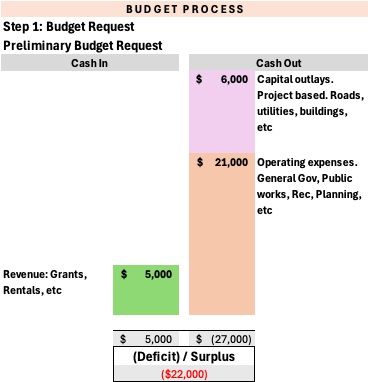
The tax setting process starts out with preliminary revenue, capital spend and expenses requests from the Town administration. The Town considers its previous year budget and long-range plans in determining its budget funding request for the new year. This process occurs over the late fall/ early winter months.
The Mayor and Council approve the budget.
There is a shortfall between the planned revenue and the planned capital and expense spending.
In the above example the shortfall or deficit is $22,000
Ontario law states municipalities are not allowed to budget an operating deficit.
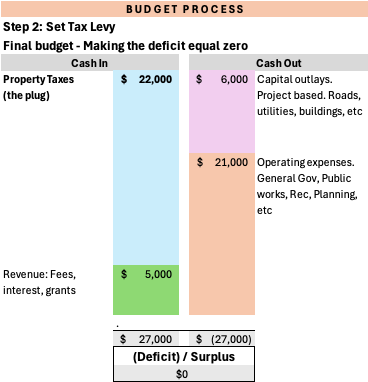
In our example above property taxes are budgeted at $22,000 to make the deficit come out to zero dollars.
Invoices are sent to all property owners and taxes are to be fully paid by September 30.
Of Note: If a municipality experiences an unexpected year-end deficit, that shortfall must be formally addressed in the following year's budget by raising revenues (such as property taxes) or cutting expenses.
Once the year is over and the books are closed the Town can determine its actual results.
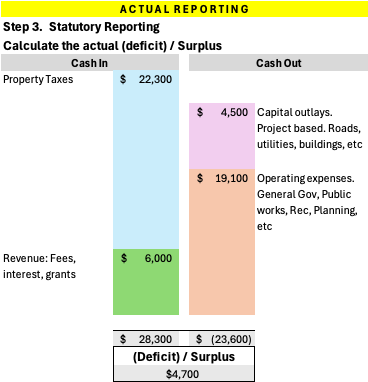
In our example property tax collection came in a little higher, revenue a lot higher. Both capital project and operating expense spending came in much lower.
When all these "actual" numbers are netted together we have a surplus of $4,700 which means the Town brought in more funds than it needed.
In the preceding example we have learned how the property tax levy is set. We also learned that by Ontario law the town is not allowed to plan for a deficit. If a deficit does occur the town is required to address it immediately by raising taxes further or by cutting spending. The town cannot cover operating deficits with long term debt.
Repeated years of significant surpluses have certainly demonstrated our desire and ability to avoid deficits but it comes with higher property tax levels that are born by us - the property owners.
To strive for more reasonable levels of taxations (surpluses) the Town needs to improve upon its planning (budgeting) accuracy and execution. An important financial management technique to help get us there is to implement more discipline around measuring our actual performance, to plan, doing it timely (quarterly? monthly?) and at a level of detail where accountability and transparency are achieved. Department level? Project level? ).
Improving Accountability & Transparency
All information presented is for illustrative purposes ony
Expanding on the format of the previous example we start to add details to help us understand why and where expenses deviated from plan or revenue increased. We begin to drill down on increasing levels of detail. The usual starting place follows the budget outline and is by cost centre.
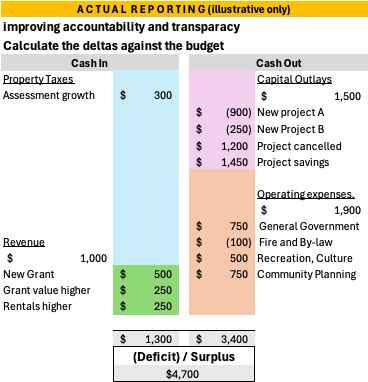
We start by asking to see the major drivers to budget deviations. Our $4,700 is detailed out further. Property taxes up $300 due to growth of 2.7% which is 1% above plan. Revenue improved $1,000 as we received a new grant of $500 to support monarch butterfly habitat. Another grant for milkweed planting came in $250 higher than budget estimate. Rentals of ice at the MCC overachieved by $250.
The Town netted $1,500 better on capital infrastructure.
Major projects increases are:
* Project A – emergency drainage management $(900)
* Project B - water pumping station $(250).
Major project decreases are:
* Cancellation of St Kitts road four lane expansion $1,500
* Projects C, D & E came below budget $1450.
Operating expenses were $1,900 lower than budget. General Gov found $750 cost efficiencies and better prices while Recreation $500 and Community planning $750 both accelerated productivity efforts. By-law was higher $(100) due to new hires and enforcement efforts.
These details total to the $4700 surplus and hopefully provide the reader sufficient information to assess the Town's financial performance against budget for the year.
This narrative of financial results starts providing transparency on how the town performed in different areas. The reader can begin to assess what areas performed well or otherwise. More relevant questions can now be asked. We can begin to recognize those that met or overachieved on their financial commitments and those that did not.
We can drill down deeper.
We ask for critical success factors for each area, agree upon them, and then measure performace with them. We should be reviewing staffing/payroll costs by cost centres , contract services, maintenance, ice surface utilization, etc.
In the example shown we are detailing out the actual surplus into the cost centres, projects and revenue streams which deviated from budget. This provides more transparency. It provides more specifics around performance and areas to hold accoutbale.
Eventually with these processes planning accuracy will improve as managers become more familiar and accountable for their spending. We become more transparent with Council and more accountable to the public. Eventually annual property tax levies will be based on improved estimates. Surpluses should shrink while avoiding deficits